-
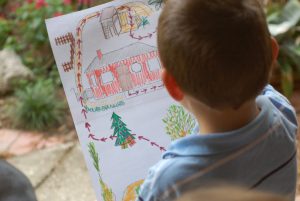 When you’re confronted with a challenging workplace problem and need to get out of habitual patterns of thought, draw a map.
As John Medina points out in Brain Rules, human brains developed in an ancestral environment that required constant motion—up to 12 miles a day of walking. His point is that exercise is necessary for improving thinking skills. While I wouldn’t dispute that, it’s also true that drawing maps puts your imagination into motion. Mapping activates your spatial awareness and gives you access to dimensions of thinking that aren’t available when you’re trying to power through a difficult problem with your thought-stream alone. Creating mental space: that’s one of the key benefits of drawing a map.
In Sylvie and Bruno Concluded, Lewis Carroll explores the question of mapping and scale:
We very soon got to six yards to the mile. Then we tried a hundred yards to the mile. And then came the grandest idea of all! We actually made a map of the country, on the scale of a mile to the mile! It has never been spread out, yet, the farmers objected: they said it would cover the whole country, and shut out the sunlight! So we now use the country itself, as its own map, and I assure you it does nearly as well.
Carroll’s 1:1 scale is wonderfully absurd: it points out that maps have value because they don’t show everything. They distill the complexities of a landscape down to their significant essences. Mapping is choice-making, and when you put pen to paper to articulate the contours of the dilemma you’re facing, you are editing out the trivial so you can see what really matters.
Drawing a map can also put you in touch with a sense of adventure. Like an explorer or a treasure-seeker, you’re not just burdened with a tedious difficulty: you’re on a path of discovery, peering through a mysterious landscape, making sense of it, determining what you know and what you don’t know, and beginning to trace out the path that will take you where you need to go.
Try It: Render a current creative challenge you are facing in two-dimensional space. You can draw simple thought bubbles, use basic geometric shapes, or sketch an imaginary landscape. The specifics of what you draw, and its artistic merit, is far less important than the activity of creating a sense of space and movement, making choices as to what’s important to represent, and cultivating a sense of adventure and curiosity in the face of the unknown.
Image: Erik (HASH) Hersman, https://creativecommons.org/licenses/by/2.0/